---
title: "FAQ: About Time Clauses"
description: A practical article on time clauses, their uses, and risks and benefits.
---
[Skip to content](https://help.pembertonagentadvantage.ca/faq-about-time-clauses#main-content)
English - Canada
Show submenu for translations

Open main navigation
Close main navigation
- English - Canada
Show submenu for translations
- [Contact us](mailto:service@phre.ca)
[Contact us](mailto:service@phre.ca)
Ask us a question!
- There are no suggestions because the search field is empty.
1. [Support & Resources](https://help.pembertonagentadvantage.ca/?hsLang=en-ca)
2. [FAQs](https://help.pembertonagentadvantage.ca/faqs?hsLang=en-ca)
# FAQ: About Time Clauses
## A practical overview of Time Clauses and their uses in real estate transactions in VREB and VIREB.
**Table of Contents: **
[The Purpose of Time Clauses](https://help.pembertonagentadvantage.ca/faq-about-time-clauses#purpose-of-time-clauses)
[Required Forms and Documentation](https://help.pembertonagentadvantage.ca/faq-about-time-clauses#required-forms)
[Key Differences between VREB and VIREB](https://help.pembertonagentadvantage.ca/faq-about-time-clauses#key-differences)
[Strategic Use and Negotiation of Time Clauses](https://help.pembertonagentadvantage.ca/faq-about-time-clauses#strategic-use)
[Risks and Common Pitfalls](https://help.pembertonagentadvantage.ca/faq-about-time-clauses#risk-and-common-pitfalls)
---
#### **Summary**
A time clause is most commonly used when a buyer needs to sell their existing property before completing a purchase. It allows the seller to continue marketing the property, potentially accept another offer, and gives the seller the option to trigger a notice period that forces the original buyer to remove their conditions.
There are important distinctions between the forms used in VIREB and VREB. Of particular note are the differences between when a seller can trigger the clause and how notice periods are calculated.
There are scenarios where an agent may wish to amend a time clause to better protect their client. These scenarios are described at the bottom of this article.
---
#### **The Purpose of Time Clauses**
Time clauses are primarily used in situations where a buyer must sell their existing property before completing the purchase of a new one. They provide a structured mechanism that balances the buyer's need for time with the seller's interest in keeping the property marketable. Rather than locking a seller into a potentially uncertain transaction, the clause allows the seller to continue entertaining offers.
At its core, a time clause gives the buyer a defined period to sell their property. During this time, the seller retains the right to trigger the time clause that requires them to remove all of their subject conditions. This is done when a second offer is received and accepted by the seller. If the buyer fails to remove conditions, the contract collapses and the seller is free to accept offers unencumbered.
**The History of Time Clauses and Today's Standardization: **
Historically, time clauses were manually written into contracts, often including custom language such as allowing the seller to trigger the clause with 24 hours’ notice upon receiving another offer. Today, these provisions are standardized into board-approved forms, such as “Time Clause Form 1.”
Despite this standardization, many agents still include redundant wording like “subject to the sale of the buyer’s house, see attached time clause.” While not necessary, this duplication remains common practice and does not cause harm.
---
#### **Required Forms and Documentation**
Accurate use of forms is essential in managing time clause transactions. An overview of the various forms and downloadable copies of each are provided below.
**Downloadable versions of these forms are meant as examples only, ensure you download the most up to date forms through WebForms for your contracts. **
**VIREB:**
1. [Form I - Time Clause:](https://help.pembertonagentadvantage.ca/hubfs/Form%20I%20-%20Time%20Clause.pdf?hsLang=en-ca) Establishes that the offer is conditional on the buyer selling their existing home, while also allowing the seller to continue marketing the property. Additionally, this form sets a firm deadline for the buyer to enter into an unconditional arrangement, and outlines how the notice will be triggered and to whom the notice will be delivered.
2. [Form II - Time Clause Subsequent Sale:](https://help.pembertonagentadvantage.ca/hubfs/Form%20II%20-%20Time%20Clause%20Subsequent%20Sale.pdf?hsLang=en-ca) Used when a second buyer submits an offer and acknowledges the existence of the first (conditional) contract. This form ensures that the second buyer understands that their position depends on the first buyer's response.
3. [Form III - Time Clause Letter of Notification: ](https://help.pembertonagentadvantage.ca/hubfs/Form%20III%20-%20Time%20Clause%20Letter%20of%20Notification.pdf?hsLang=en-ca)This form is issued by the seller after accepting a bona-fide second offer and triggers the time clause. This form specifies the exact deadline by which the first buyer must remove conditions.
**VREB:**
1. [Time Clause Form I:](https://help.pembertonagentadvantage.ca/hubfs/Time%20Clause%20Form%20I.pdf?hsLang=en-ca) Similar in principle to the VIREB Form I, with slight (but very important) changes to the language. Of note is the requirement for the second offer to be condition free before notice can be triggered (including the rescission right).
2. [Time Clause Form II - Subsequent Sale:](https://help.pembertonagentadvantage.ca/hubfs/Time%20Clause%20Form%20II%20-%20Subsequent%20Sale.pdf?hsLang=en-ca) Again, similar in concept to the VIREB Form II, with the exception that the notice period includes Saturday, Sunday and Statutory holidays.
3. [Time Clause Form III - Letter of Notification: ](https://help.pembertonagentadvantage.ca/hubfs/Time%20Clause%20Form%20III%20-%20%20Letter%20of%20Notification.pdf?hsLang=en-ca)Again, similar in concept to the VIREB Form III, with the exception of the changes to the notice period timeline.
4. [Time Clause Form IV - Subject Removal:](https://help.pembertonagentadvantage.ca/hubfs/Time%20Clause%20Form%20IV%20-%20Subject%20Removal.pdf?hsLang=en-ca)This form is used only in VREB to confirm that the first contract is now firm. VIREB uses an amendment to perform this function.
**Tip:** Since delivery of notice is considered effective upon email, agents can complete most of the notice form in advance, including the exact deadline for condition removal. However, caution should be taken in calculating the notice period. Errors in timing can invalidate notice and potentially reset the process.
**Important: **Time clause forms must follow the same format as the initial time clause. For example, a contract written with a VIREB time clause, subsequent forms must use the VIREB variant and vice versa.
---
#### **Key Differences Between VIREB and VREB Forms**
Although the general concept of time clauses is consistent, there are critical differences between VIREB and VREB forms that significantly affect how transactions unfold.
1. **Conditional Period of the Second Offer:** The first major difference relates to when a seller can trigger the time clause. Under the VIREB form, the seller can trigger the clause immediately upon accepting a second offer. They do not need to wait for the second buyer to remove their conditions. This gives sellers more flexibility and leverage.In contrast, the VREB form requires that all conditions in the second offer be removed before the seller can trigger the time clause. This delays the process and provides the first buyer with more time and security.
2. **Difference in Notice Period Calculation:** The second key difference involves how notice periods are calculated. The VIREB form excludes Saturdays, Sundays, and statutory holidays, effectively extending the buyer’s response time. The VREB form, however, counts all calendar days, which can shorten the practical window for the buyer to act.
These distinctions can materially affect negotiation strategy and risk exposure and a prudent agent should understand these differences well.
---
**Strategic Use and Negotiation of Time Clauses**
Time clauses are highly negotiable and can be tailored through amendments or additional language. One common modification is delaying when the seller can trigger the clause. For example, a clause may state that the seller cannot issue notice until the buyer has had sufficient time to complete standard due diligence, such as inspections.
This modification protects buyers from incurring costs (such as inspection fees) only to have the deal jeopardized immediately afterward. It aligns the transaction more closely with standard contracts, where buyers typically have uninterrupted time to satisfy conditions.
**Delay of Time Clause Invocation:**
> The Seller agrees that the (X) hour time clause shall not be invoked within (X) days of the acceptance of this offer.
Another strategic variation involves limiting when the time clause can be invoked if the buyer has accepted an offer on their own property. Without protective language, a buyer could find themselves in a precarious situation: their property is conditionally sold, but they are forced to remove conditions on their purchase before those conditions are satisfied.
To address this, contracts can include language preventing the seller from triggering the time clause during the buyer’s condition period, often capped at a reasonable duration such as 10–14 days.
**Delay of Time Clause Invocation for Conditional Offer on Buyer's Property:**
> The Seller agrees that the (X) hour time clause shall not be invoked within 10 days of the Buyer’s acceptance of a conditional offer on their property to allow time for subject removal. The Buyers shall immediately notify the Seller in writing upon acceptance of such conditional offer.
---
#### **Risks and Common Pitfalls**
Several risks arise when time clauses are not carefully managed. One of the most significant is the overlap of condition periods. If a buyer accepts an offer on their property with conditions and the seller simultaneously triggers the time clause, the buyer may be unable to proceed, creating legal and financial complications.
Another common issue is the absence of clear expectations around listing and marketing the buyer’s property. Sellers may face situations where buyers delay listing or attempt to sell privately, reducing the likelihood of a timely sale. To mitigate this, sellers often require assurances that the property will be listed on MLS within a specific timeframe.
There is also the risk of unrealistic pricing. A buyer may list their property at an inflated price, effectively stalling the transaction. While contracts may not fully prevent this, due diligence (such as discussing pricing strategy with the buyer’s agent) can help identify potential concerns early.
**Considerations for Second Buyers and Backup Offers**
When a second buyer enters the picture, additional complexities arise. Second buyers often include clauses preventing the seller from amending the first contract or extending condition periods. This ensures that the second buyer is not left waiting indefinitely while the first deal evolves.
However, such restrictions can create challenges for sellers. If issues arise during inspections (such as repairs or environmental concerns) the seller may need to amend the first contract. Prohibiting amendments entirely could jeopardize both transactions.
A more balanced approach is to restrict extensions of condition periods rather than all amendments. This protects the second buyer while preserving the seller’s ability to address legitimate issues.
**Additional, Unique Scenarios: **
**1. Stacked Time Clauses: **Consider this situation, a Seller has an accepted offer from a buyer that is subject to the sale of the buyer's property (Time Clause #1). The seller wants to place an offer on another property (the Replacement Property) with a condition that the offer is subject to the sale of their own property (Time Clause #2).
There is a specific risk to the Seller that the owner of the Replacement Property will call their time clause before the Buyer of their own property has removed their subject to sale. In this case, the Seller needs to be able to call Time Clause #1 in order to be able to remove their subject to sale condition (Time Clause #2). This requires a specific addition to the contract of purchase and sale within the **Notice **section of Time Clause Form I (or Form I - Time Clause for VIREB).
See example:
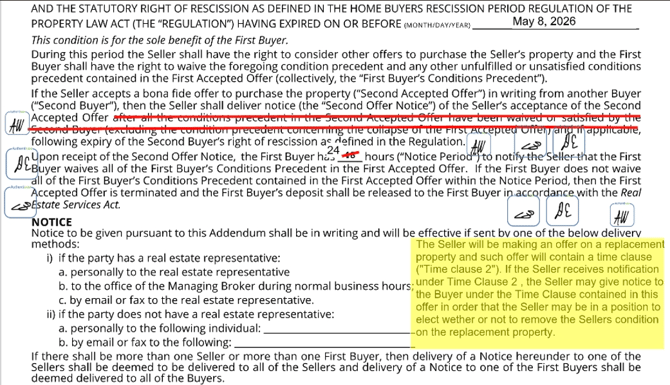
*The Seller will be making an offer on a replacement property and such offer will contain a time clause ("Time Clause 2"). If the Seller receives notification under Time Clause 2, the Seller may give notice to the Buyer under the Time Clause contained in this offer in order that the Seller may be in a position to elect whether or not to remove the Seller's condition on the replacement property.*
---
#### **Conclusion**
Time clauses are powerful tools that enable flexibility in real estate transactions involving contingent sales. However, their effectiveness depends on a thorough understanding of their structure, careful drafting, and proactive risk management. Differences between board forms, strategic amendments, and the handling of multiple offers all play a critical role in determining outcomes.
Ultimately, while time clauses are common, they introduce complexity that requires attention to detail and clear communication. When used thoughtfully, they can facilitate successful transactions; when overlooked, they can create significant challenges for all parties involved
If you have questions regarding time clauses, reach out to your managing broker for the most current and applicable advice.
- [Getting started](https://help.pembertonagentadvantage.ca/getting-started?hsLang=en-ca#main-content)
- [General](https://help.pembertonagentadvantage.ca/getting-started?hsLang=en-ca#general)
- [Transaction Software](https://help.pembertonagentadvantage.ca/getting-started?hsLang=en-ca#transaction-software)
- [Board Software](https://help.pembertonagentadvantage.ca/getting-started?hsLang=en-ca#board-software)
- [FAQs](https://help.pembertonagentadvantage.ca/faqs?hsLang=en-ca)
- [BoldTrail Help](https://help.pembertonagentadvantage.ca/boldtrail-help?hsLang=en-ca)
- [Contracts](https://help.pembertonagentadvantage.ca/contracts?hsLang=en-ca#main-content)
- [Offers](https://help.pembertonagentadvantage.ca/contracts?hsLang=en-ca#offers)
- [Marketing](https://help.pembertonagentadvantage.ca/marketing?hsLang=en-ca)
- [Buyers & Sellers](https://help.pembertonagentadvantage.ca/buyers-sellers?hsLang=en-ca#main-content)
- [Sellers](https://help.pembertonagentadvantage.ca/buyers-sellers?hsLang=en-ca#sellers)
- [Buyers](https://help.pembertonagentadvantage.ca/buyers-sellers?hsLang=en-ca#buyers)
- [Open Houses](https://help.pembertonagentadvantage.ca/buyers-sellers?hsLang=en-ca#open-houses)
- [Financing](https://help.pembertonagentadvantage.ca/buyers-sellers?hsLang=en-ca#financing)
- [Negotiations](https://help.pembertonagentadvantage.ca/buyers-sellers?hsLang=en-ca#negotiations)
[](http://www.joinpembertonholmes.com)
[mailto:email@email.com](mailto:email@email.com)
Copyright © 2026, Pemberton Holmes Ltd.